
Thagzo – The art of weaving is an essential part of Bhutan’s cultural heritage in the thirteen traditional arts and crafts that have been practiced from the immemorial time. The textile shows a side of the Bhutan culture in vibrant colours, sophisticated patterns and the intricate dyeing and weaving techniques. These complicated techniques have been developed and practiced widely for ages, throughout the history of the kingdom.
The Bhutanese pride themselves in the art of creating these beautiful and unique textiles. They wear these textile clothes almost every day. Bhutan government has made the national dress the standard to be worn during official setups (men wear Gho, women wear Kira), giving the people a unique identity. In almost every Bhutanese house, you can come across some connections to a weaver or weaving. Tourists have found this fascinating when taking our Bhutan textile tour, and they want to learn more and more about the country’s art of weaving.
For centuries, the Bhutanese have been wearing the beautiful and delicate textiles. As the textile production moves beyond the confines of clothing to the artistic expression of individuals and communities, patronage from the royal household is vital. The role and the influence of royal women in sustaining and promoting the weaving tradition are very important. One of the most influential figures is Her Majesty the Queen Mother Ashi Sangay Choden Wangchuck, who has extended beyond royal household patronage to the textile industry. Her Majesty’s interest and intervention have revitalised Bhutanese textiles, and brought the world attention to this beautiful and delicate weaving art. She is the Royal Patron of the Bhutan Textile Museum and the Chairman of the Royal Textile Academy of Bhutan (RTAB).
In the Bhutan culture, the art of weaving is strongly associated with religion, therefore, master weavers are highly respected by people. Today, weavers are mostly women, but there are a few men who are master weavers as well. Women of eastern Bhutan are very skilled at weaving, and some of the most highly prized textiles are woven by them. Some people believe that when a textile is woven by a man, it becomes a Sungma/ Sungkay or an amulet – an object to ward off negative energy and keep away the demonic forces. This belief is also an encouragement for men to learn the weaving art as the trend is declining.
Interestingly, although knowledge of the Bhutanese traditional patterns has been passed down through generations only as an oral tradition and without any written records, most of the motifs from the ancient days are still woven and in vogue until now. Nevertheless, time has surely taken its toll. Some of the motifs are not as common they used to be anymore. Some motifs are difficult to locate, such as the Lungta or the horse and other animal figures and those of the likes of the Torma. These designs now are mostly collected samples, which can only be seen in the museums, and you may not see them wore by the Bhutanese.
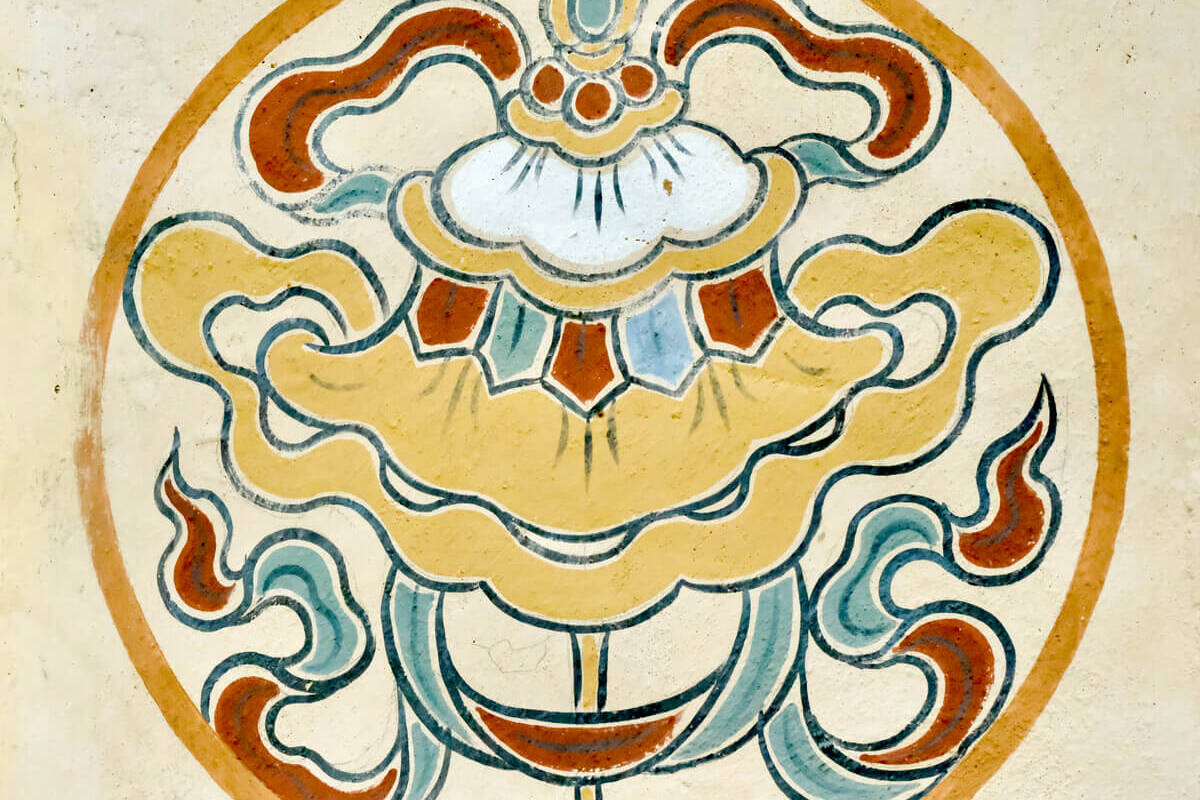
The name of every textile product expresses its own distinctive combination of colours, design, pattern and fibre. Weaving pattern is either stripes – vertical for men, and horizontal for women in cotton, silk or wool. Extra designs are made by adding warp threads. Patterns like the vajra (thunderbolt), the swastika, the tree or the wheel, each has their symbolic meanings. Not only the symbols in Bhutanese textiles are primarily of geometric nature, they also possess deep religious meanings for people. Some common symbols include the Dorje, the Drame, the Phenphenma, the Phub, the Yudrung, and the Shinglo.
The Drame (or the eternal knot) is a classic Buddhist symbol. This again shows the importance of Buddhism in the cultural heritage of Bhutan. The Phenphenma is a symbol of butterfly and the eight-pointed star, while the thunderbolt (Dorji Jadram) represents the indestructible powers of Buddhism. The Phub (or rainbow) is a triangle pattern with successive rainbow colours. The Sorjephub pattern is created by incorporating the Dorje symbol within the phub symbol. The most difficult pattern to weave – the Shinglo symbol is for the royal and noble family. The Shinglo symbol represents the “tree of life”.
The Therpochay (Jana chagri) or the China Wall pattern is usually seen next to the Phub design on kiras. The Therpochay symbol is believed to have been originated from the designs on Chinese brocade. The Yudrung is the crossroad where the four directions meet, and it symbolises the balancing forces of the universe, when rotating. The Yudrung is an ancient pattern with its epicentre is considered a spiritual place. Bhutanese weavers usually weave two types of textiles; the plain-woven is karchang, and the pattern woven textile called Metochem.
In the past, the weaving process used to be more complicated and time-consuming, with 12 steps in total. It started with collecting the dyes and fibre, spinning (Kheyney, Zheyney) and finally dyeing the yarn. They then laid out the thread in its preliminary format (Gongni). This was followed by the laying out of the warp (Jemni). The weaver eventually arranged the positioning of the weft, called Mam Sham Ni. For very complex and detailed designs that required a whole lot of Tsang Dum usage, the process of weaving in the patterns is referred as Metho Thuni. On the horizontal loom, the weave must be arranged once the desired length of the weave had been achieved. People refer this step as Thag Di Ni. As the second last stage of the weaving process, finishing touches were added onto both ends to prevent them from splitting apart. The final step is Tha Toh Ni or cutting the weave off from the loom. For Kiras, there was yet another step – Rep Kheyni or arranging and trimming the two ends. If the Kira was patterned, the reverse sides of the weave were trimmed.
Through the complicated process of weaving and under the skilled hands of the masters, the beautiful and sophisticated textiles are made. It is the beauty of the Bhutanese’s cultural heritage that you need to see when visiting the kingdom. As unique as the weaving art is, you cannot find it anywhere outside Bhutan. So we are honour to bring you closer to the culture of Bhutan with our designed tour. In our Bhutan textile tour, you can learn to know how the weaving masters work and they can explain to you the smallest details of these patterns. This experience will give you a whole new insight into this ancient art as a part of life in Bhutan, besides the stunning views of scene and the warmth of the people, and these textiles also make the perfect gifts to take back home.
Culture & Heritage
Ready to Explore Bhutan?
Let us craft your perfect Bhutanese adventure
Plan Your Journey